



Authored By: Jaideep Saraswat & Tushar Katiyar
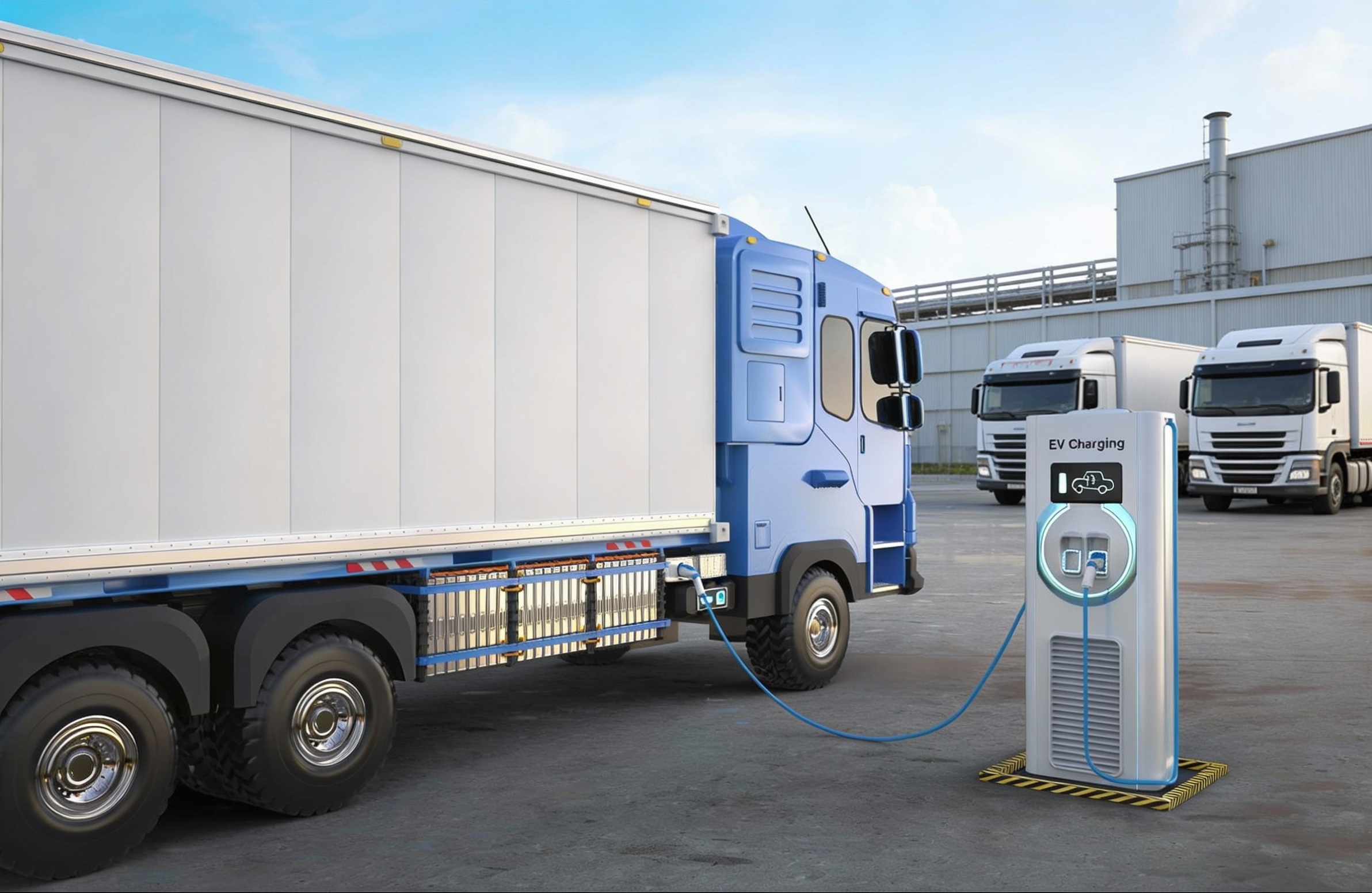
The trucking sector plays an integral role in supporting global economic activity, driven by population growth, urbanisation, infrastructure development, and expanding trade. So, decarbonising the trucking sector is essential to ensure its carbon emissions align with international and national climate targets. In India, where road transport accounts for the majority of freight movement, decarbonising trucking is critical.
Electrification of trucks is often discussed in sweeping terms, dominated by concerns around range anxiety, charging infrastructure, high upfront costs, uncertainty around residual value, and operational reliability. While these concerns are valid, the conversation misses out on evidence from real-world operations, including data that reflects how trucks actually perform under commercial duty cycles rather than theoretical assumptions.
Electric trucks are moving beyond pilot programs into early commercial deployment, evident from the more than 500 units sold in 2025. Hence, on-ground operational data is beginning to offer clearer answers. This data not only highlights how electric trucks already perform, but also how their economics compare with diesel trucks across different use cases.
This article draws on real-world operational data averaged across multiple electric trucks deployed in three applications: off-road, mining, and on-road fixed-route freight. These insights are benchmarked against observed performance metrics of diesel trucks operating in comparable Indian conditions. Rather than treating trucking as a single, homogeneous activity, the analysis reflects a practical reality: trucks operate under very different duty cycles, and their economics must be evaluated accordingly.
Understanding Duty Cycles: Why Time Matters as Much as Distance
A key insight from real-world deployments is that trucking operations are not universally distance-driven.
Off-road and mining applications are fundamentally time-based. Productivity is measured in hours of operation (how long the vehicle can work in a shift), rather than kilometres travelled. In contrast, on-road freight operations are distance-based, where kilometres covered per day determine asset utilisation and commercial viability.
This distinction is critical because it shapes both energy consumption patterns and cost accumulation, and it explains why electric trucks perform very differently across applications.
Off-Road Operations: Electric Trucks in Stop-Start Environments
In off-road applications such as construction sites and logistics yards, a 45-tonne GVW electric truck typically consumes around 20 kWh per hour, resulting in an energy cost of approximately ₹170 per hour. It operates for roughly 12 hours per day.
The significance of this goes beyond lower energy costs. Off-road environments are characterised by frequent stop-start operation and extended idling—conditions under which diesel engines are inherently inefficient. Electric drivetrains, by contrast, draw energy only when required. The absence of idling losses results in a more predictable and efficient operating profile, particularly in constrained or congested sites.
A comparable diesel truck in off-road use typically consumes 15–30 litres of diesel per hour, translating to ₹1,350-₹3,000 per hour at prevailing fuel prices. It is a significant difference from the ₹170 per hour cost of an electric truck, which widens further when factoring in higher maintenance needs and fuel wasted during idling, costs that are structurally embedded in diesel operations.
Mining Applications: High Energy Demand, High Electric Advantage
Mining presents one of the most demanding duty cycles for any truck: long operating hours, heavy loads, steep gradients, and frequent braking.
Real-world data from electric mining trucks shows energy consumption of nearly 40 kWh per hour (for a 60 GVW truck), resulting in an energy cost of approximately ₹400 per hour. The vehicles operate for up to 18 hours per day.
One of the most compelling advantages of electric trucks in mining applications is regenerative braking. Nearly 25 per cent of total energy used is recovered during downhill runs or deceleration-heavy cycles, energy that diesel trucks simply lose as heat. Beyond energy savings, regenerative braking significantly reduces brake wear, a major maintenance cost and downtime factor in mining fleets.
In contrast to diesel trucks in similar mining conditions, which face high hourly fuel consumption, accelerated brake wear, and increased maintenance intensity, electrification is particularly attractive in this segment despite higher upfront costs.
On-road Freight Fixed-Route: Cost per Kilometre Tells the Story
For on-road fixed route freight, comparisons are more straightforward because operations are distance-driven.
Observed real-world data from 55-tonne GVW diesel trucks operating on fixed routes shows an average daily distance of about 198 kilometres, with fuel consumption exceeding 66 litres per day. This observation translates to a fuel cost of approximately ₹30 per kilometre.
Electric on-road trucks operating under similar conditions consume around 2 kWh per kilometre, resulting in an energy cost of roughly ₹17 per kilometre.
So, electrification presents a nearly 43 per cent reduction in per-kilometre energy cost. For fleet operators running fixed routes or hub-and-spoke models, this cost advantage is particularly compelling. Daily distances and schedules are predictable, charging can be planned centrally, and electricity costs can be stabilised through long-term utility contracts or off-peak charging, unlike diesel prices, which remain volatile.
Battery Durability, Warranty Signals, and the Real Cost Equation
As mentioned before, beyond operating costs, fleet operators continue to weigh concerns around battery longevity and long-term reliability. That said, recent policy signals and emerging real-world evidence are strengthening OEM confidence and increasingly underscore growing trust in the electric truck ecosystem. Under India’s PM E-DRIVE scheme, electric trucks, both N2 and N3 categories, are eligible for incentives only if they meet a minimum battery warranty of 5 lakh kilometres.
To place this in perspective, the average monthly distance travelled by a medium-duty diesel truck in India is around 4000 kilometres*. At this utilisation level, a 5-lakh-kilometre warranty translates to over ten years of covered operation, significantly reducing concerns around premature battery failure and residual value for fleet owners.
This confidence is reinforced by recent research from Stanford University, which finds that real-world EV battery usage, characterised by varied acceleration, braking, rest periods, and thermal cycles, allows batteries to last substantially longer than laboratory test estimates. From a total cost of ownership perspective, these durability gains further strengthen the economic case for electric trucks. Across weight categories, battery electric trucks are already cost-competitive with diesel at annual running levels of 36,000-72,000 kilometres, with lower per-kilometre costs in most segments. This advantage is largely driven by energy costs: for electric trucks, energy accounts for about 52 per cent of total ownership costs over a 15-year period, compared with roughly 73 per cent for diesel trucks. As a result, stable electricity prices and ongoing efficiency gains play a far greater role in overall competitiveness than differences in upfront vehicle costs.
What This Means for India’s Truck Electrification Pathway
The evidence from real-world operations does not point to a one-size-fits-all conclusion. Instead, it reveals a clear hierarchy of electrification readiness.
Electric trucks are already well-suited for off-road and mining applications, where time-based operations, stop-start duty cycles, regenerative braking, and lower hourly energy costs deliver immediate operational and economic benefits. On-road freight, particularly on fixed and predictable routes, emerges as the most cost-competitive segment on a per-kilometre basis.
India’s transition from diesel to electric trucking will not happen overnight. However, early deployment data makes one point increasingly clear: electric trucks are no longer a future concept waiting for perfect conditions. In the right applications, they are already demonstrating real-world viability today.
This calls for a maturation of policy frameworks, moving beyond the question of viability toward actively supporting the large-scale deployment of electric trucks in the most suitable use cases.
*Based on real-life data collection
Authored By: Jaideep Saraswat Associate Director- Clean Power, Electric Mobility and Emerging Technologies and Tushar Katiyar, Senior Policy Officer-Clean Power, Electric Mobility, and Emerging Technologies, at Vasudha Foundation.