



Authored By: Aishwarya Tewary, Sandhya Sundararagavan, Vaishnavi T.G. Shankar, S Kanupriya Kothiwal
India’s heat burden is becoming harder to ignore. 2024 has been reported as the country’s warmest year on record, with temperatures averaging 0.65°C above normal, reflecting a broader global trend. The impacts are already visible. Between April and July 2024, 430 heatstroke deaths were reported across India. As extreme heat intensifies, its consequences are being felt across health systems, livelihoods, and urban infrastructure.
Heat impact is particularly significant in India because of the scale of outdoor and heat-exposed work. Nearly 75% of the workforce, around 380 million people, depend on heat-exposed labour and collectively contribute close to half of the country’s GDP. Rising temperatures can reduce worker productivity and affect incomes, creating risks of job losses and wider economic disruption.
The pace and pattern of urban growth further amplifies these risks. Dense built environments, limited vegetation, and extensive use of heat-absorbing materials create urban heat island effects, raising temperatures in cities by 1°C to 4°C compared to surrounding areas, with peak differences reaching up to 10°C. At the same time, heat exposure is changing in character. Studies show that very warm nights are increasing faster than very hot days, reducing opportunities for physiological recovery from daytime heat.
In this context, buildings play a critical role in shaping how heat is experienced indoors. The design and materials of buildings determine how much heat enters indoor spaces and how much cooling is required to maintain thermal comfort. Passive design strategies such as shading, solar orientation, and the use of radiative or low heat-absorptive materials can reduce heat gain and keep interiors cooler. In contrast, active cooling relies on electricity through fans, air conditioners, and other mechanical systems to lower indoor temperatures.
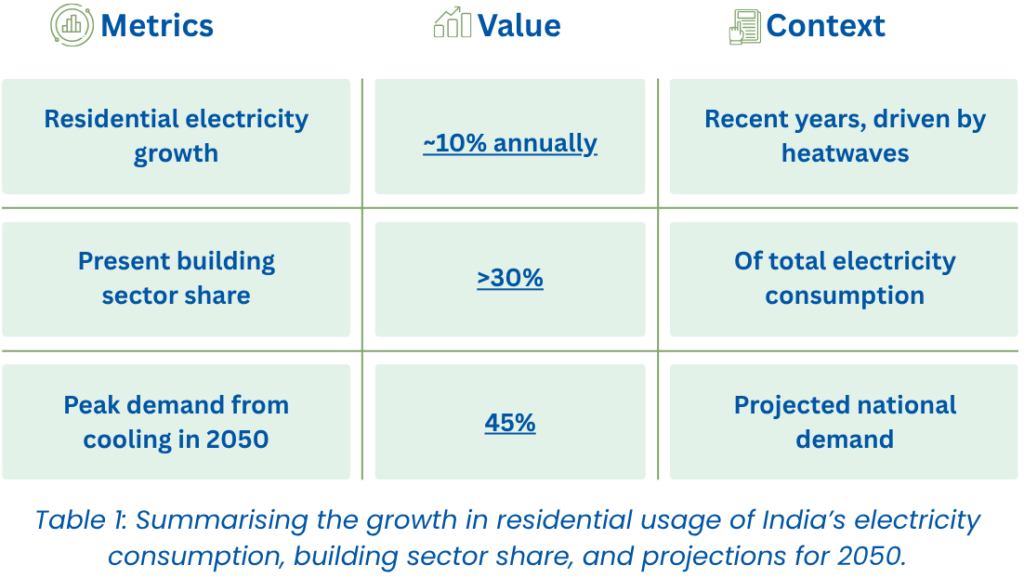
As temperatures rise, buildings are increasingly relying on electricity-based cooling to maintain indoor comfort. Residential electricity use in India has been growing at about 10% annually in recent years, and by 2050, space cooling is projected to account for 45% peak electricity demand. This trend is already visible: in 2024-25, Delhi saw one of its steepest increases in domestic electricity demand, due to higher appliance ownership and longer summers. Overall, buildings already consume over 30% of India’s total electricity consumption and continue to expand rapidly.
Rapid urbanisation is driving a surge in the built environment that, alongside changing weather patterns, intensifies urban heat island effect which in turn raises electricity demand, creating a closely linked cycle. Addressing these heat risk conditions underscores the need for coordinated, cross-sector responses rather than isolated interventions.
Recognising these connections, the Government of India has introduced several policy and regulatory measures over the past decade. The National Action Plan on Climate Change established several missions, including the Sustainable Habitat and Energy Efficiency to guide climate-responsive urban development. India also released the India Cooling Action Plan, one of the first national strategies focused on ensuring sustainable cooling and thermal comfort for all.
Regulatory measures have followed to influence both supply and demand for cooling. Energy-efficient building codes have been introduced for commercial and residential construction, while appliance efficiency standards have been strengthened through mandatory star labelling for air conditioners and temperature-setting regulations.
Heat has also been formally recognised as a disaster since 2016. By 2020, the India Meteorological Department had identified 23 heatwave-prone states. In collaboration with the National Disaster Management Authority and state health departments, Heat Action Plans have been developed to support early warnings, emergency response, and protection of vulnerable communities during extreme heat events.
At the sub-national level, every State and Union Territory has prepared a State Action Plan on Climate Change (SAPCC) outlining strategies to reduce emissions and strengthen adaptive capacity across sectors. Along with vulnerable states, districts and cities at the local level, have developed Heat Action Plans (HAPs) that emphasise practical interventions to reduce heat stress, such as shading, cool roofs and walls, and more energy-efficient cooling technologies.
To understand how these interconnected responses are evolving, we reviewed cooling-related initiatives across the country, including pilots being tested, lessons from existing efforts, enablers and barriers that continue to limit their scaling. Building on this analysis, we propose a seven-point strategy to support the scaling of cooling solutions for mainstream implementation.
State-wise Mapping of Cooling Action Across India
Mapping done till 31 st March, 2026
Use the interactive map below to explore cooling initiatives across states, hover over each state to view details on actions, pilots, and policies.
The spread of HAPs reveals a mixed but growing landscape, starting with Ahmedabad releasing South Asia’s first city HAP. A few cities are now moving beyond conventional heat responses toward structured cooling strategies. Gujarat’s Rajkot emerged as India’s first city to develop an urban cooling action plan and a framework. Odisha’s Bhubaneswar further advanced the approach by launching the country’s first Integrated Heat and Cooling Action Plan. More recently, Gurugram became the latest city to unveil its own Cooling Action Plan.
Passive Cooling Interventions: Small Changes, Measurable Relief
Increasing incidents of heatwaves and a push towards sustainable cooling solutions saw a rise in pilots that have been translated into policies, and vice versa. Many of these solutions draw their foundations from traditional cooling practices, now being adopted by governments and scaled through bottom-up/community-led initiatives.
Cool roof pilot projects were first rolled out in Hyderabad and Ahmedabad in 2017 and 2018, respectively, as part of efforts to combat extreme heat. The success of these cool roof pilots through its people‑centric, cost-effective elements led to states across the country taking up cool roofs, cool walls, green roofs, green walls, among others, as a way towards thermal comfort. According to studies, passive strategies like these can achieve an indoor temperature decrease of 2.2°C; a cooling load reduction of 31%, energy savings of 29%, and a thermal comfort hour extension of 23%. Evidence from India, and even international pilots like Indonesia, where indoor temperatures dropped by up to 10°C, confirms their effectiveness.
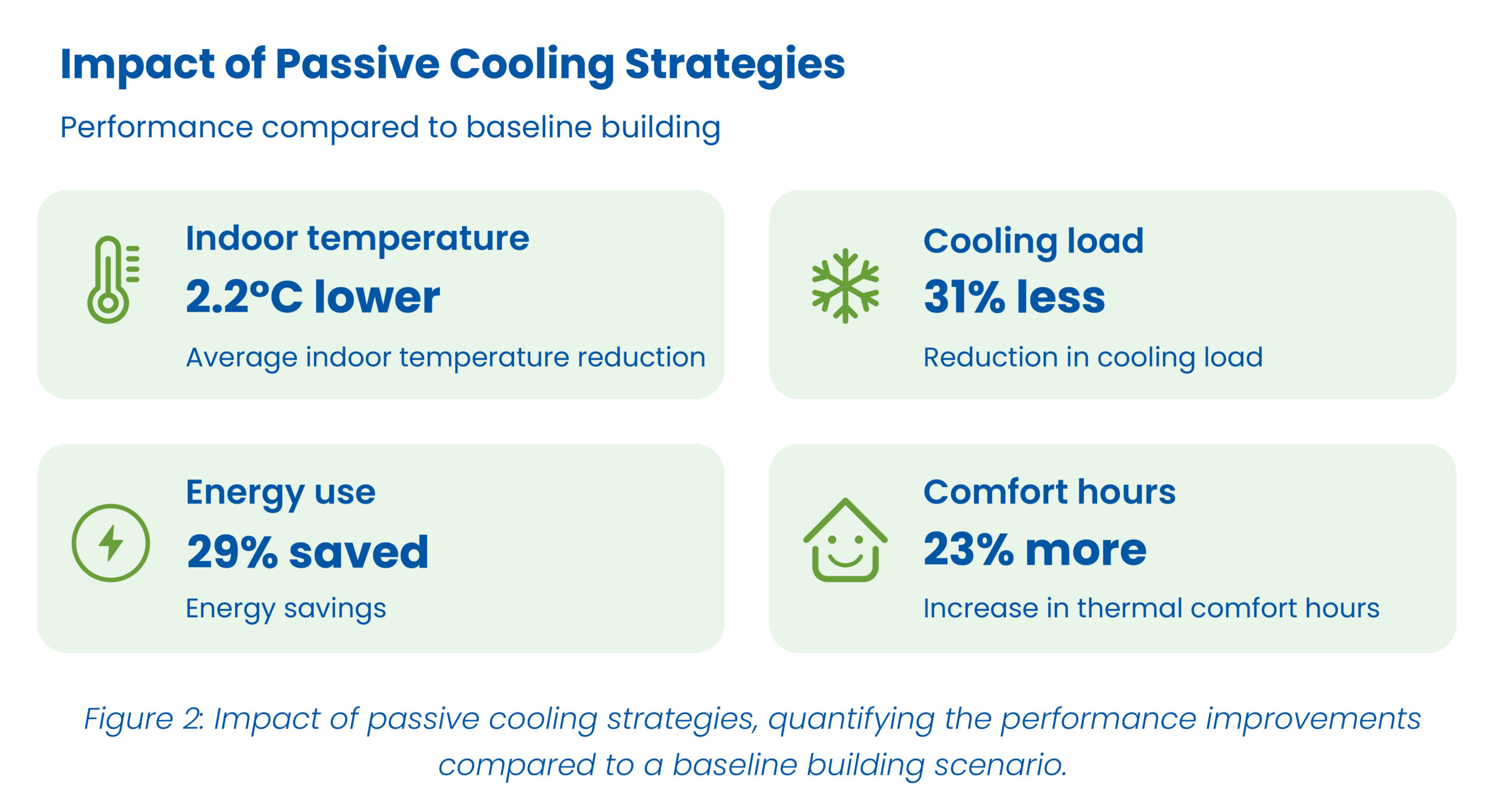
Emerging evidence demonstrates that such passive measures can deliver measurable reductions in indoor temperatures and energy consumption, while enhancing thermal comfort for vulnerable populations. The following examples illustrate how pioneering cities and states have moved from isolated pilots to structured programmes and, in some cases as policies.
Our review shows that these pilot initiatives have been successful towards becoming a policy, with states creating targets to achieve sustainability, while in other cases, pilots were initiated after the introduction of a regulatory/policy measure.
From Pilots to Policies
Out of all the states and UTs, eight can be highlighted as those that have translated their pilots into policies or action plans towards implementation in combatting heat.
- Following the deadly 2010 heatwave, when temperatures in Ahmedabad touched 46.8°C and caused 1,344 excess deaths in May alone, the city released South Asia’s first Heat Action Plan. As part of its implementation, a cool roof pilot covered 3,000 low‑income homes, reducing indoor temperatures by 2–5°C compared to traditional roofs. Its success led to the formal integration of a Cool Roof Programme in Ahmedabad’s updated Heat Action Plan in 2019. Gujarat followed this with a State Heat Action Plan in 2020, recommending cool roof programmes across departments. Cities such as Jamnagar, Junagarh, Surat, Mahesana, and Rajkot embedded thermal comfort and passive cooling, especially cool roofs into their own Climate or Heat Action Plans. Rajkot released the country’s first Framework for an Urban Cooling Action Plan. Through the Pradhan Mantri Awas Yojana, the Rajkot Municipal Corporation implemented Smart Ghar III, integrating passive cooling, thermally efficient materials that reduced indoor temperatures by 1–3°C, on‑site clean energy, and cool walls (using thermally efficient materials such as autoclaved aerated concrete blocks in the building shell, cavity walls, highly reflective materials for the roof, partially glazed casement windows).
- In order to streamline passive cooling measures in buildings, Telangana in 2019 became the first state to mandate the Energy Conservation Building Code (ECBC) for commercial buildings under municipal laws, embedding techniques such as improved building envelopes, shading, natural ventilation, and reduced heat gain into everyday construction. Following the success of the cool roof pilot in Hyderabad, Telangana became the first state to bring in a cool roof policy in 2023, with a target of achieving 300 sq. km of cool roof area by 2028.
- Bhopal’s cool roof pilot in 2020, resulting in 2–5°C cooler indoors, led to this being integrated within Bhopal’s City Climate Action Plan (CCAP) as a medium-term goal. Subsequently, the cities of Gwalior, Ujjain, Jabalpur, and Satna included cool roofs in their CCAPs. District of Indore in Madhya Pradesh included the same in its District Climate Action Plan. What began as a pilot became a practical, scalable adoption plan across Madhya Pradesh.
- Following a community-led cool roof pilot in Uttar Pradesh’s capital, Lucknow, there has been the implementation of HAP in Prayagraj, while a draft Urban Cooling policy is underway. UP released the “District-Wise Heat Threshold Determination in Uttar Pradesh and India” to provide a thorough analysis of heat wave thresholds at the district level, to create its independent early warning system and recommend measures that can be taken up to mitigate heat.
- In Rajasthan, following Jodhpur and Dungarpur’s cool roof pilots of applying solar reflective paint in villages, this was further embedded within the SAPCC. Churu’s HAP mentions reviving “traditional Rajasthani climate-adaptive architectural design (lime plaster lining in the inner walls absorbing humidity while releasing it slowly, thick stone walls, earthen floors, and mud plaster naturally insulating interiors, inner courtyards, jaali windows, verandas, and jharokhas enabling passive cooling and cross ventilation), to withstand the region’s intense desert heat”. Jodhpur’s HAP mentions blue coating of walls, while Jaipur’s 2007 Municipal Corporation ordinance requires all buildings in the old city to maintain pink façades, thereby retaining its pink city identity. The specific “pink” shade, a blend of red and white known locally as *gair* or *surkhi* was derived from natural minerals and lime. Rajasthan has adopted traditional and climate-appropriate design practices, helping keep buildings cooler.
- Tamil Nadu has been pioneering in its efforts towards urban heat resilience and sustainable cooling practices. In 2023, the state partnered with UNEP to launch a comprehensive Urban Cooling Programme, shifting the focus from managing heat to reducing it inside buildings. The Heat Resilience Centre was launched as a nodal hub coordinating heat‑risk action across departments and building technical capacity. Further, the state scaled up cool roofs in government schools, becoming the first in India to do so, and began integrating passive cooling into affordable housing. It is now poised to become the country’s first state to mandate minimum passive cooling standards in all new buildings. These initiatives have translated into action on the ground: 11 of Tamil Nadu’s 15 cities joined the global Beat the Heat Implementation Drive, gaining access to tools and support to expand passive and nature‑based cooling. In 2024, the state formally declared heat a state‑specific hazard and released Beating the Heat: A Heat Mitigation Strategy, which blends policy with practice, highlighting projects like Thannal Natural Homes in Tiruvannamalai that revive traditional techniques such as shaded courtyards, lime‑based materials, red oxide flooring, verandas, and chhajjas.
- The Maharashtra State Action Plan on Climate Change and Human Health tasks the Nodal Health Department with ensuring inter-sectoral coordination to advance climate-resilient green building design, energy-efficient cooling and heating, and increased plantation. Forty-four cities have joined the UNFCCC Cities Race to Zero, with commitments to net zero emissions and developing zero-carbon buildings through energy code compliance, decarbonised construction, and building retrofits. Notable city initiatives include Amravati’s focus on cool and green roofs; Chhatrapati Sambhajinagar’s promotion of energy-efficient buildings and cool roof integration; Solapur’s priority on urban heat and greening; and Mumbai’s comprehensive Climate Action Plan (MCAP), which aligns financial planning with net-zero goals and released India’s first city-level Climate Budget Report. Other efforts include Nagpur’s regional heat action plan, Mira Bhayandar and Raigad’s advocacy for cool roofs, and Pune’s pioneering Eco-Housing programme with incentives for green buildings. District and city plans across Sangli, Satara, and Pune also highlight thermal comfort, green roofs, and cool pavements as key heat mitigation strategies in their DDMPs.
- Karnataka’s HAP promotes cool roofs, including green walls and roofs, to reduce indoor heat. Several districts, such as Ballari and Bengaluru, recommend cool roofs as interventions. Vijayanagara has a HAP, while Vijayapura’s plan addresses both heatwaves and lightning. Karnataka was among the first Indian states to adopt the Energy Conservation Building Code (2007) and included it in Model Building Byelaws by 2021. In November 2023, Bangalore launched its Climate Action and Resilience Plan, focusing on energy, transport, waste, water, urban planning, biodiversity, and disaster resilience. The Climate Action Cell was established in February 2024 to oversee implementation of the plan. Bengaluru has taken several architectural initiatives to combat urban heat, for instance the Kempegowda airport terminal 2 also known as ‘garden airport’ demonstrating energy efficiency and commitment to sustainability.
From Policies to Pilots
These experiences indicate a gradual but discernible shift from experimental approaches to institutionalised cooling strategies. Rather than cataloguing every initiative in detail, the focus below is on a set of representative cases that show how pilots have informed policy design, regulatory change, and large-scale implementation. Of all the States and Union Territories, four are highlighted as those that have initiated pilots after introducing a state-led regulations:
- Cool roof pilots in Andhra Pradesh’s Visakhapatnam, Kakinada and Bapatla villages with different varieties (cool roof with false ceiling and cool roof without false ceiling), lead to a 4-11°C reduction in indoor temperature. Following this, the city of Visakhapatnam, in its Green City Action Plan, mentioned that it will promote cool roofs (through its Eco-Vizag Campaign) for 25% of residential and commercial buildings, covering 1.5 million m2 of rooftop area by 2034.
- Kerala’s ‘Kulirma’ scheme, led by the Energy Management Centre, aims to turn building roofs across the state into cool roofs, starting with a pilot in Thiruvananthapuram. The Asia Low Carbon Buildings Transition project is helping identify where passive design can replace energy‑intensive cooling. The state is one of the first in the country to have notified the latest ECBC 2024, a first step in the path towards low-carbon buildings. This momentum has pushed the state toward a draft Cool Roof Policy.
- Odisha’s 1998 heat wave, which led to 2000 casualties, acted as a trigger for the state to release a State Heat Action Plan in 1999, being the first state to do so. Further, it is the state which released the nation’s first Integrated Heat and Cooling Action Plan (IHCAP) for Odisha’s Bhubaneswar. IHCAP recommends solutions around cool roofs, passive cooling strategies, efficient cooling appliances, and cooling shelters. Following this cool roof pilots are initiated.
- Chandigarh adopted the concept of green building as a long-term measure towards minimising energy utilisation. It also lists energy efficient building practices and strategies as part of its Sustainable Habitat Mission. Its building code 2023 recommends that all roofs should be either cool roofs or vegetated roofs, except those that are covered by solar photovoltaic, or solar hot water, or any other renewable energy system, or utilities and services.
The Way Forward
While these initiatives represent important progress, they also reveal systemic gaps that must be addressed to ensure sustained, equitable and scalable cooling outcomes. The following section outlines key areas where policy, regulation and institutional mechanisms need to be strengthened.
- Traditional Architecture as a Climate Solution: The IPCC recognises indigenous and traditional knowledge as vital for climate adaptation. India already offers strong examples with Churu’s climate‑responsive desert architecture, Jaipur’s pink façades, Jodhpur’s blue cityscape, and Tamil Nadu’s emphasis on vernacular‑inspired materials like lime, mud, and plant derivatives. These indigenous building techniques (such as jalis, thick walls, high ceilings, and chhajjas) are time-tested, climate-suited solutions that effectively combat heat and reduce energy use. Odisha’s Krushi Bhawan in Bhubaneswar is an example which demonstrates how traditional design and modern engineering can work together. Its staggered form, double skin façade, and night purging system cut heat gain by up to 40% and lower indoor temperatures by 7–8°C, allowing 80% of the building to function without air conditioning. Integrating such method in new buildings, particularly government buildings can be helpful in pioneering examples of reduction in energy consumption and achieving sustainability.
- Targeting Government Buildings for Sustainable Transition: A critical starting point towards mainstreaming sustainable cooling and energy efficiency is to mandate that all government buildings transition toward green standards by drawing lessons from early movers such as Pimpri Chinchwad Municipal Corporation and Chandigarh Municipal Corporation.
- Stronger focus on mainstream adoption: All states and UTs have prepared State Action Plans on Climate Change, and at least 17 recommend cooling measures such as cool roofs, cool walls, green roofs, and traditional shading and ventilation. While these signals growing awareness, most measures remain advisory. Promoting the rollout of these interventions at scale is the need of the hour. Gurugram’s Cooling Action Plan offers a useful model, linking cooling measures to incentives, clear key performance indicators, and regular monitoring.
- Scaling mandates: Telangana’s state‑wide cool roof policy stands out as a government‑led mandate rather than a pilot. Its replication efforts in Kerala and Uttar Pradesh highlight the need for states to move decisively from experimentation to scale, ensuring consistent improvements in indoor thermal comfort. In addition, states should implement strong monitoring, evaluation learning frameworks to assess the impact of these roll-outs and generate actionable evidence to support replication tailored for their specific needs.
- Closing the building code gap: Despite regular updates to national building codes, state‑level adoption lags. For example, Madhya Pradesh notified the 2017 code only in 2024. Cities like Chandigarh and Jaipur, to name a few, show how this gap can be bridged by embedding green building and region‑specific design requirements directly into building bylaws. This will be in alignment with the local climate realities while preserving regional identity.
- Ensuring performance through O&M: Cooling measures must be backed by clear operation and maintenance mandates, timelines, and accountability. Incentives and penalties can help ensure compliance. Maharashtra offers a working example, where Pune and Pimpri‑Chinchwad provide tax rebates and incentives for GRIHA and Indian Green Building Council (IGBC) certified buildings, supported by inspections.
- Planning beyond heatwave management: Most HAPs focus on management and emergency response rather than long‑term heat reduction. Efforts such as Tamil Nadu’s heat vulnerability assessment and Uttar Pradesh’s district‑wise heat thresholds show how ground realities and planning can proactively guide local action. Institutions like Tamil Nadu’s Heat Resilience Centre demonstrate how states can support cities and districts through capacity building. Integrating Heat Action Plans with Cooling Action Plans, as seen in Bhubaneswar, helps combine short term heat management strategies with long term cooling solutions.
India’s urban heat crisis is no longer a distant threat, it is a present emergency demanding decisive action. Every delay in updating building codes or scaling pilots could potentially result in higher electricity demand, rising health risks, and mounting economic losses. The country doesn’t need to start from scratch; it already has proven, homegrown solutions. From Telangana’s cool roof mandate to Tamil Nadu’s comprehensive heat action strategy and Gurugram’s city-level plan, the building blocks exist. What is missing is the scale and urgency. These successes must now be elevated into implementation on the ground. A decisive policy shift today can transform isolated wins into a nationwide framework for cooler, healthier, and more resilient cities.
Authored By: Aishwarya Tewary, Policy Officer, Sandhya Sundararagavan, Senior Advisor – Climate and Energy Resilient Innovation, Vaishnavi T.G. Shankar, Senior Advisor – Climate Resilience and Sustainable Cities, Kanupriya Kothiwal, Senior Policy Officer