



Authored By: Vrinda Gupta & Srinivas Ethiraj
The first part of our series examined how process heat sits at the centre of competitiveness for India’s textile sector, and why its emission profile is increasingly shaping access to global markets. But beyond emissions and compliance, process heat also defines another, less discussed dimension of competitiveness: stability and security of energy supply. Recent geopolitical disruptions, particularly in West Asia, have once again exposed the vulnerability of fuel-dependent industrial systems, bringing the question of energy security to the forefront.
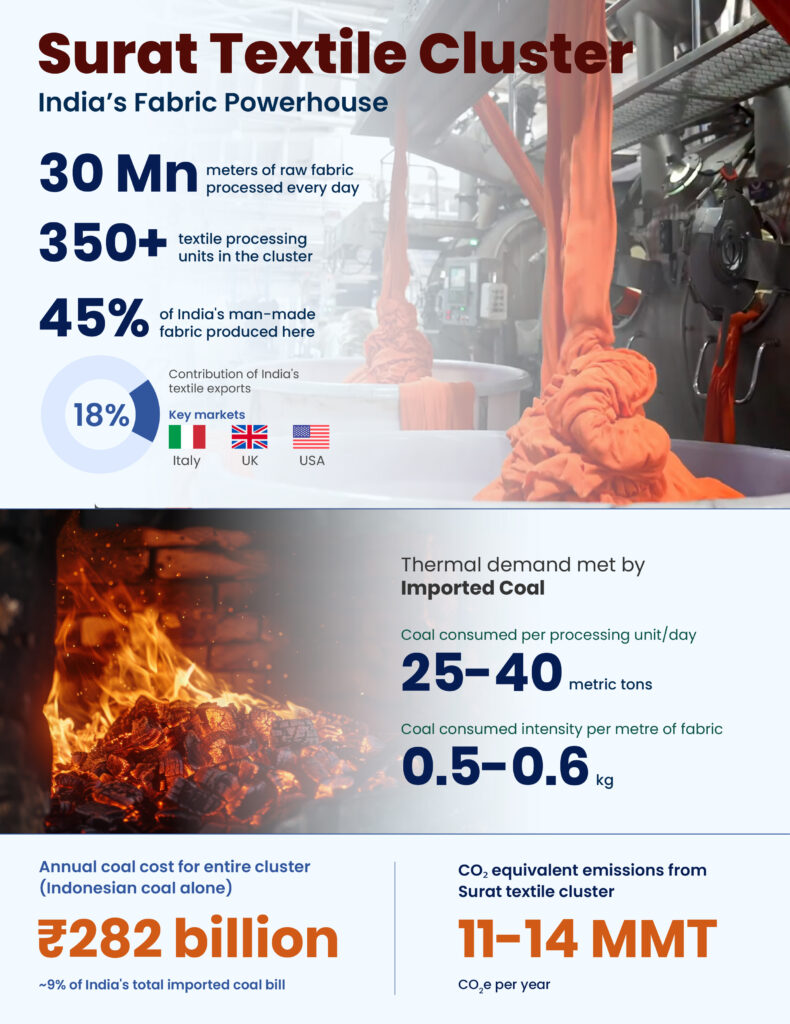
Understanding how this plays out requires a closer look at large textile processing hubs such as Surat in Gujarat. With over 350 textile processing units, Surat plays a central role in India’s upstream textile value chain. The cluster accounts for around 18 per cent of the country’s textile exports to markets such as Italy, the United Kingdom, and the United States, produces nearly 45 per cent of India’s man-made fabric and processes close to 30 million metres of raw fabric every day.
This scale is strengthened by an equally significant dependence on thermal energy. Much of Surat’s textile processing ecosystem relies on continuous, high-volume process heat, supplied largely through coal, lignite, and gas-based heating systems. This makes fuel availability, fuel quality and fuel price movements foundational to how reliably and affordably these units can operate.
This dependence is not limited to Surat: it reflects a broader sectoral trend. According to our analysis, between 2009-10 and 2002-23, overall energy consumption in India’s textile sector increased by 25 per cent, while coal consumption rose by 86 per cent, underscoring the sector’s deepening reliance on fossil fuels and the growing challenge of decarbonising industrial heat.
A majority of textile processing thermal demand in Surat is met through solid fuels such as imported coal, embedding the cluster deeply within the global fuel supply chains. For a typical processing unit, this translates to 25–40 metric tons of coal consumed every day, meaning roughly 0.5–0.6 kg of coal is consumed for every metre of fabric that is processed. This makes fuel not just an input, but one of the single largest determinants of operating cost, just like raw materials and labour costs. While imported coal dominates this fuel mix, units are forced to rely on lower-grade fuel such as lignite during periods of Indonesian coal unavailability or an increase in price. Industry estimates suggest that a 30–35 per cent increase in the landed cost of coal can raise processing costs by 8–12 per cent, forcing units to either pass on costs, cut operations, or absorb losses in an already margin-constrained environment.
Lignite accounts for around 18 per cent of total solid fuel consumption on average, with its share rising to as high as 53 per cent during periods of supply disruption. Lignite carries more moisture and ash and delivers less heat per kilogram than imported fuel. That means burning more fuel to get the same amount of energy, which increases emissions and decreases overall system efficiency. At the same time, multiple fuel grades introduce operational complexity because variations in fuel mix affect combustion, making heat delivery less predictable.
Such fuel disruptions get further compounded by vulnerabilities within domestic fuel supply systems. These include seasonal constraints affecting lignite mining and dispatch, transportation bottlenecks, periodic reductions in fuel allocations and logistics costs rising as high as 42 per cent in some periods. Fuel risk also extends beyond solid fuels. Units reliant on Petroleum Natural Gas (PNG) / Regasified Liquified Natural Gas (RLNG) for high-temperature processes such as stentering, drying, and thermic fluid heating in dyeing and printing operations have also faced supply constraints and sharp price increases.
Together, dependence on imported fuels, vulnerable domestic supply chains, and gas-based heating expose the cluster to multiple levels of energy security risks. For Surat’s textile processors, this continuous volatility translates directly into cost pressures and temporary shutdowns. The impact extends beyond financial costs. Production cycles, operating days, and working capital are all affected by fluctuations in fuel availability and prices. In labour and energy-intensive sectors like textiles, such disruptions cascade across the value chain, affecting livelihoods across enterprises, suppliers, and buyers.
As a result, a system dependent on energy emerges and stands structurally exposed. Competitiveness, socio-economic concerns and energy security all get tied around the thread of fuel volatility. Yet this exposure is not just a risk but points to a broader transition opportunity.
Electrification not only offers a pathway to decarbonise industrial heat but also a route towards greater energy stability and resilience. Unlike combustion-based systems exposed to import shocks, electrified heat can increasingly benefit from renewable energy-backed power procurement arrangements that improve price predictability and offer greater control over energy costs. It can also enable higher thermal efficiency, reduce operational inefficiency, and support higher uptake of domestic renewable energy. In that sense, it is as much about energy security and system resilience as it is about decarbonisation.
Policy makers and industry stakeholders must begin viewing industrial electrification not just as a climate solution, but as a strategic level for energy security. Enabling access to reliable renewable power, supporting industrial electrification technologies, and strengthening grid readiness will be critical to reducing fuel-linked vulnerabilities in the manufacturing sector. At the same time, building capacity and creating awareness across ecosystem players: from industry and utilities to technology providers and financiers, will be essential to accelerate adoption and scale these solutions effectively.
The next part of this series turns from fuel risks to process heat itself, unpacking how heat is generated and used across textile processes, where inefficiencies arise, and how these dynamics help build the case for electrification.
Authored By: Vrinda Gupta, Associate Director – Energy Transition, and Director – Strategy and Innovations & Srinivas Ethiraj, Assistant Manager – Energy Transition