



Authored By: Vrinda Gupta & Srinivas Ethiraj
In the first two parts of this series, we built the case for electrification from two interlinked perspectives. The first examined how clean process heat is becoming central to export competitiveness in a climate-conscious market, while the second explored how dependence on fossil fuels exposes the textile industry clusters to fuel price volatility and energy security risks. In this part, we move from global to local — unpacking the internal energy architecture of textile processing units in Surat. While the complexity of steam making industrial decarbonisation appear daunting and deeply context-based, a closer look at the system inefficiencies of traditional heating reveals why electrification is the industry’s most compelling bet for long term resilience.
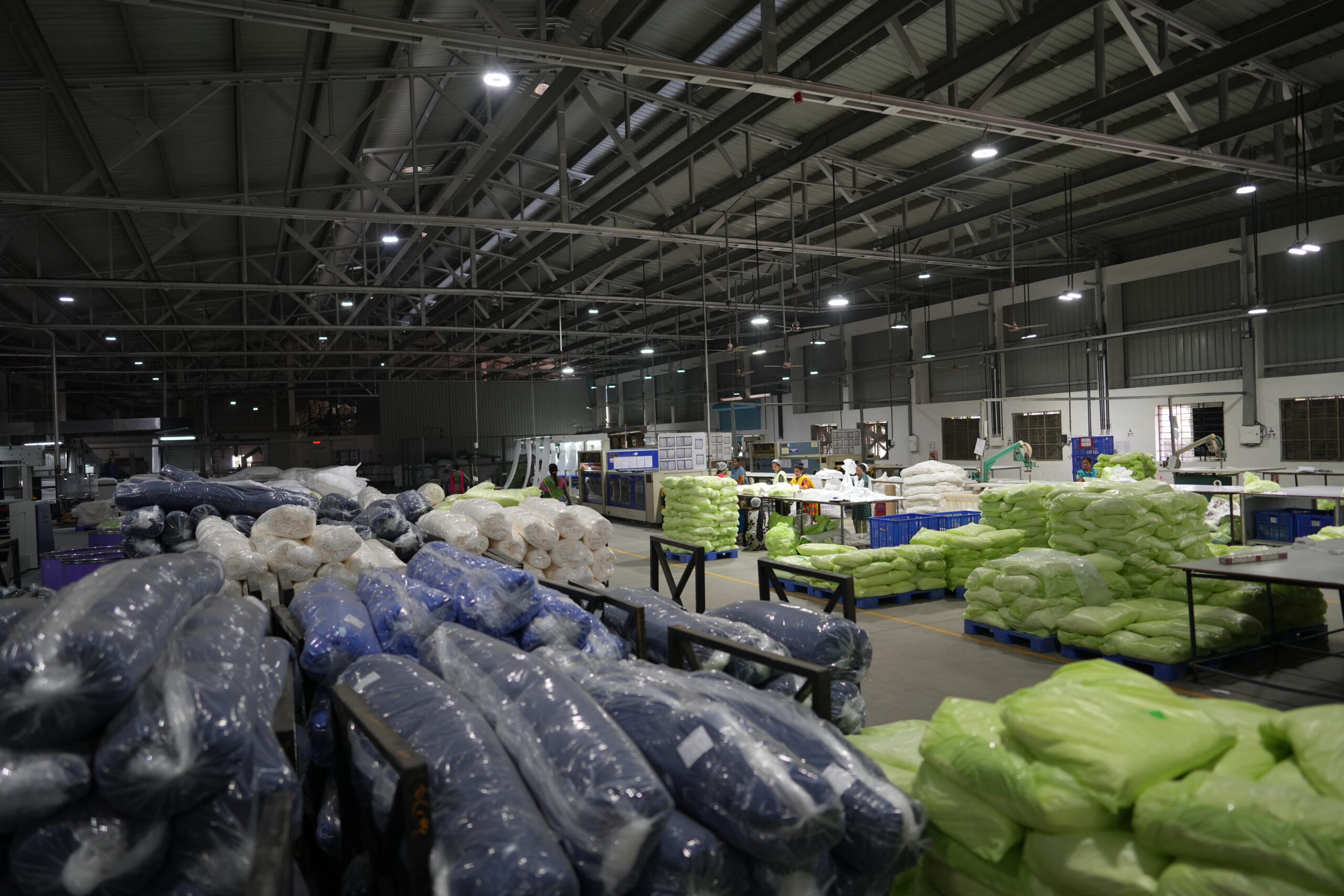
We looked closely on how process heat is actually produced and used inside textile units. Surat, one of the largest hubs for human-made fiber processing, offers a useful lens through which we examine these dynamics. Beyond scale and competitiveness, Surat also reflects a deeper structural reality of India’s industrial system: its dependence on fossil-fuel-based thermal energy. This dependence is rooted in how energy is produced and consumed within the sector. For a typical textile processing unit in Surat, nearly 92 percent of total energy demand is thermal and only 8 percent comes via electricity. This nine-to-one ratio matters immensely; making heat a harder problem to solve than electricity.
When we break this down by process, three things become instantly clear about heat:
First, there are many ways to deliver process heat. Different heating technologies serve different process needs, like steam, hot water, and hot air. However, they all rely on fossil fuels.
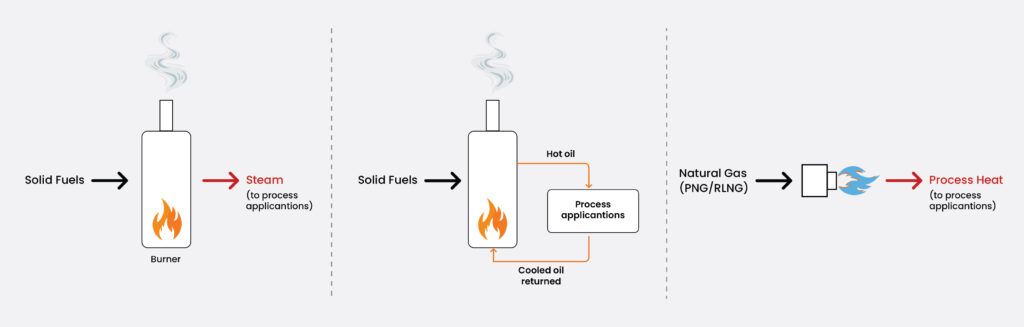
Industrial Heat Delivery Pathways in Textile Processing.
Second, steam-based systems dominate; delivering 59 percent of heat against 41 percent from thermic fluid heaters. Dyeing, Printing, and Washing — the core wet processing processes — all require steam and run primarily on steam boilers. Thermic fluid heaters are used for applications such as surface heating and drying.
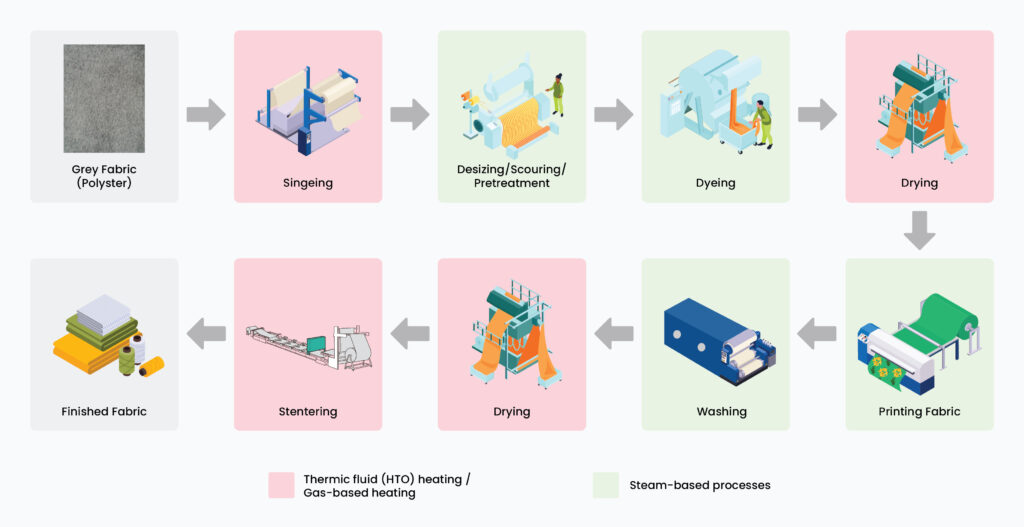
Third, process heat demand isn’t uniform. It varies significantly over time and across technologies, reflecting fluctuations in production cycles as well as differences in operating conditions. In a typical unit, thermal demand ranges from an average of around 4 MWth to peaks of roughly 5.6 MWth .
But the significance of these patterns lies not only in how much heat is used, but in how that heat is generated and delivered currently.
They collectively point towards inefficacies. A key part of this inefficiency lies in the way boilers, which generate steams, are designed and operated. Many are sized for anticipated peak loads or future production growth rather than typical operating demand. Even where cumulative installed capacity may be around 7–8 tonnes per hour (TPH), units often operate at only 40–50 percent of that capacity, particularly outside peak production cycles. The mismatch carries consequences. Boilers perform best near rated loads; sustained part-load operation raises specific fuel consumption, lowers efficiency, and increases stress on equipment. In effect, more fuel is burned to deliver less useful heat.
However, the inefficiency runs deeper. A closer look at steam utilisation reveals that a significant share of steam in textile processing never directly touches the product. Instead, it is often used for indirect applications such as heating water, maintaining tank temperatures, or warming surfaces such as rollers and stenters. Indicative process mapping suggests roughly three-quarters of steam demand in textile wet processing is associated with indirect heating applications.
So, there is a broader thermal mismatch. In many cases, high-pressure steam is generated at 120–160 degree Celsius for low-temperature applications such as drying, pre-treatment, and some part of dyeing that only require heat less than 100 degree Celsius. The temperature mismatch leads to energy quality mismatch.
Not all heat is equal. High temperature steam is high grade energy which can do much more work than the process actually demands. Deploying it for lower grade energy applications is inherently wasteful. It is like using a hammer to crack a nut.
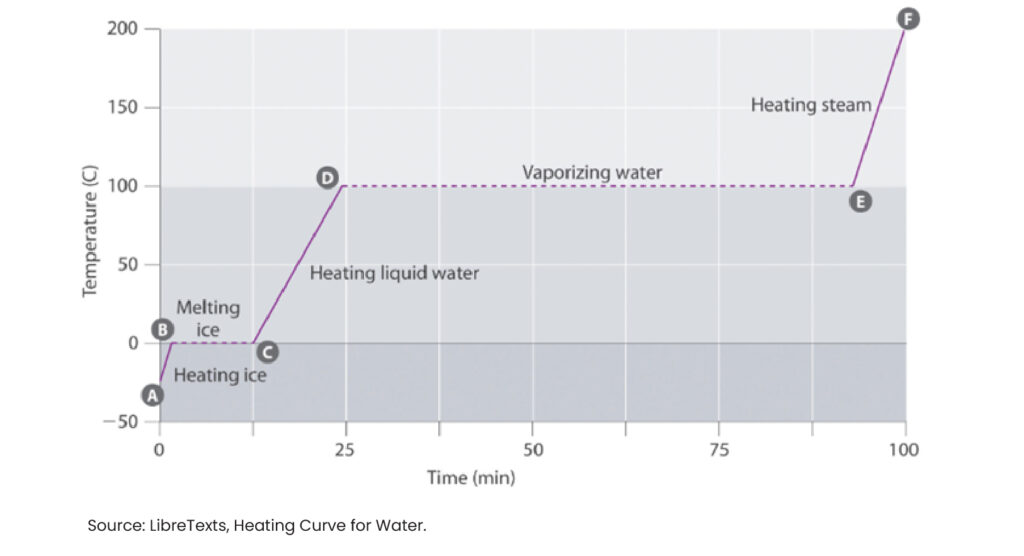
The heating curve below makes this distinction clearer. While sensible heat raises water temperature (curve C–D), the phase-change region (curve D–E) requires substantial additional energy (2,260 kJ/kg) without increasing temperature. In industrial boilers, this latent heat constitutes a significant share of the energy carried in steam.
Structural Costs Embedded in Conventional Thermal Infrastructure
These system mismatches are reinforced by the age and design of existing infrastructure. Many units in the cluster continue to operate ageing boiler systems, often with manual feeding and limited automation. While such systems may appear cost-effective because capital costs have long been depreciated, their actual cost structure is more complex. Fuel handling, labour, maintenance, ash disposal, and environmental compliance all add to the real cost of steam generation, which are not accounted for while comparing with other cleaner alternatives. In reality, what appears to be low-cost heat from boilers is a system that is operationally rigid and fossil fuel-dependent system with hidden costs that are often overlooked.
Overall, these inefficiencies/gaps make the current moment, a critical entry point for decarbonisation of industrial heating. As many of these boiler systems approach the end of their operational life, textile units are entering a reinvestment cycle. The question is no longer whether to invest in thermal infrastructure, but whether to reinvest in conventional fuel-based systems or transition toward cleaner heating pathways. Reinvesting in conventional systems just doesn’t mean buying another boiler. It means locking in coal dependence, thermal mismatch, and carbon liability for another 25 to 30 years — closer to India’s net zero target.
The inefficiencies embedded within conventional heating systems also create a transition opportunity. As many textile units enter a reinvestment cycle, electrification offers an alternative to move beyond rigid and fuel-intensive thermal infrastructure.
The next part of this series moves to actual costs and solutions for transitioning to cleaner heating opportunities, where we will understand the cost of electrification and compare it across heating pathways and the policy, finance, and market instruments needed to support early adoption among MSMEs.
Authored By: Vrinda Gupta, Associate Director – Energy Transition, and Director – Strategy and Innovations & Srinivas Ethiraj, Assistant Manager – Energy Transition