



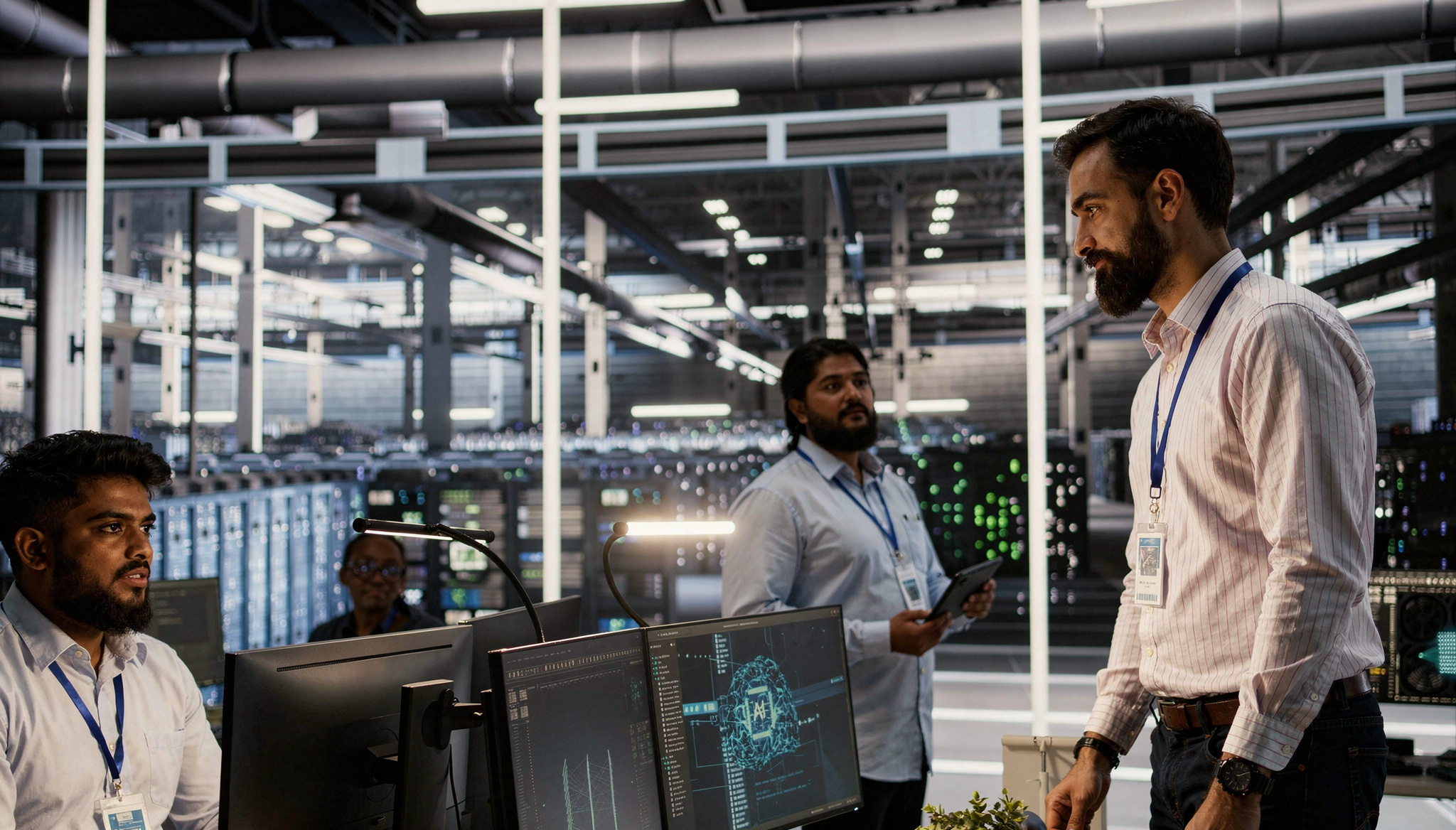
As India is racing into the age of artificial intelligence with new data centre incentives, the impact of hyperscale data centres on the power sector has attracted disproportionate attention. It has led to a central question: What about the burgeoning power needed for AI implementation at scale? Moreover, the data centres are sources of waste heat that needs to be removed at scale. As AI turns into physical infrastructure, its hunger for electricity — and the heat it leaves behind — is becoming impossible to ignore.
While the scale of the challenge is real, the conclusion that it is inherently unmanageable, is not. The impact of AI on the power-sector impact is substantial, but not intractable. To address the concerns, system-level optimisation of the renewable energy transition matters more than ever.
Power and Heat Challenges Are Real
Yes, data centres are power hungry. When deployed in clusters numbering in the tens of thousands, the aggregate energy demand of accelerators in data centres is substantial.
Moreover, there is no Moore’s Law for energy. Energy systems do not benefit from exponential scaling laws. Electricity generation, transmission, and cooling are governed by physical constraints, particularly the laws of thermodynamics. Every unit of electrical energy consumed by a data centre is converted into heat which must be removed, while every additional megawatt of demand must be physically supplied through generation and networks. Unlike computer performance, energy efficiency improvements tend to be incremental rather than exponential. Moreover, improvements in chip-level performance per watt are often outpaced by the growth in total workloads, leading to an overall increase in electricity consumption and scepticism about efficiency gains.
But They Are Not Intractable
Gross energy consumption figures alone do not paint the full picture. Energy intensity and system impact are not fixed characteristics of data centres — they are shaped by design choices, operational strategies, and policy frameworks.
Studies have shown that data centre energy performance varies dramatically across facilities, depending on the efficiency of chip-level performance. Differences in cooling architecture, airflow management, power distribution, and operational control can result in several-fold differences in total facility energy use for the same IT load. Energy efficiency in data centres is a result of better design, smarter controls, and tighter integration with power systems.
Managing the Impact on the Power Sector
The most important yet often overlooked aspect of AI data centres is that they are highly controllable consumers of electricity. Unlike conventional industrial loads, a significant portion of AI workloads, particularly model training, is time-flexible. Training tasks can be paused, rescheduled, or shifted geographically without affecting end-user experience. Inference workloads, while sensitive to execution times, typically represent a smaller share of total energy use. This distinction enables data centres to actively respond to grid conditions rather than passively contributing to demand.
If workload is distributed intelligently, data centres can align their highest energy consumption with periods of low system demand or high renewable generation. Training workloads can be shifted to off-peak hours, relocated to regions with surplus renewable power, or temporarily curtailed during grid stress events. In doing so, AI compute becomes a form of demand-side flexibility, capable of supporting grid stability rather than undermining it. As power systems integrate higher shares of variable renewable energy, such flexible demand becomes increasingly valuable.
Location strategy further strengthens this opportunity. There is no technical requirement for hyperscale data centres to be located within dense urban centres, where distribution networks are often already under strain. Instead, these facilities can be strategically sited near renewable energy clusters, transmission hubs, or regions with available generation capacity. For India, this presents a significant advantage. By aligning data centre development with renewable energy-rich regions, it is possible to reduce congestion, improve renewable utilisation, and create stable, high-volume, and long-term demand that supports large-scale clean energy investments.
Moreover, data centres can be integrated into grid operations through storage and flexibility mechanisms. Many hyperscale facilities already deploy battery systems for reliability. When designed with grid interaction in mind, these systems can be optimised to shift energy usage from peak hours (when demand is high) to off-peak hours, reducing strain on the grid, rather than just providing backup power. Coordinated flex-connect arrangements with utilities allow data centres to reduce grid draw during peak hours while maintaining operational continuity through on-site storage. Because these batteries are sized for limited-duration support rather than full-load backup, capital costs remain manageable while system benefits are substantial.
Finally, proactive planning at the state level is essential. Mapping grid capacity, identifying zones suitable for data centre deployment, and clearly articulating upgrade pathways can significantly reduce uncertainty for investors while preventing ad hoc strain on power infrastructure. When combined with strong efficiency standards and performance benchmarks, such planning ensures that new data centre capacity contributes to long-term system resilience rather than short-term stress.
The impact of data centres on the power sector is not an uncontrolled externality but a design challenge. AI-driven data centres will undoubtedly increase electricity demand, but they also offer unprecedented flexibility, scale, and investment potential. If integrated thoughtfully, they can accelerate renewable energy deployment, strengthen grid economics, and support the transition to a more digital and decarbonised power system. Demonstrating this balanced, system-oriented approach may prove to be India’s most important contributions to the global AI discourse.
Authored By: Jaideep Saraswat Associate Director- Clean Power and Electric Mobility, and Nikhil Mall Senior Manager – Clean Energy and Power Sector