



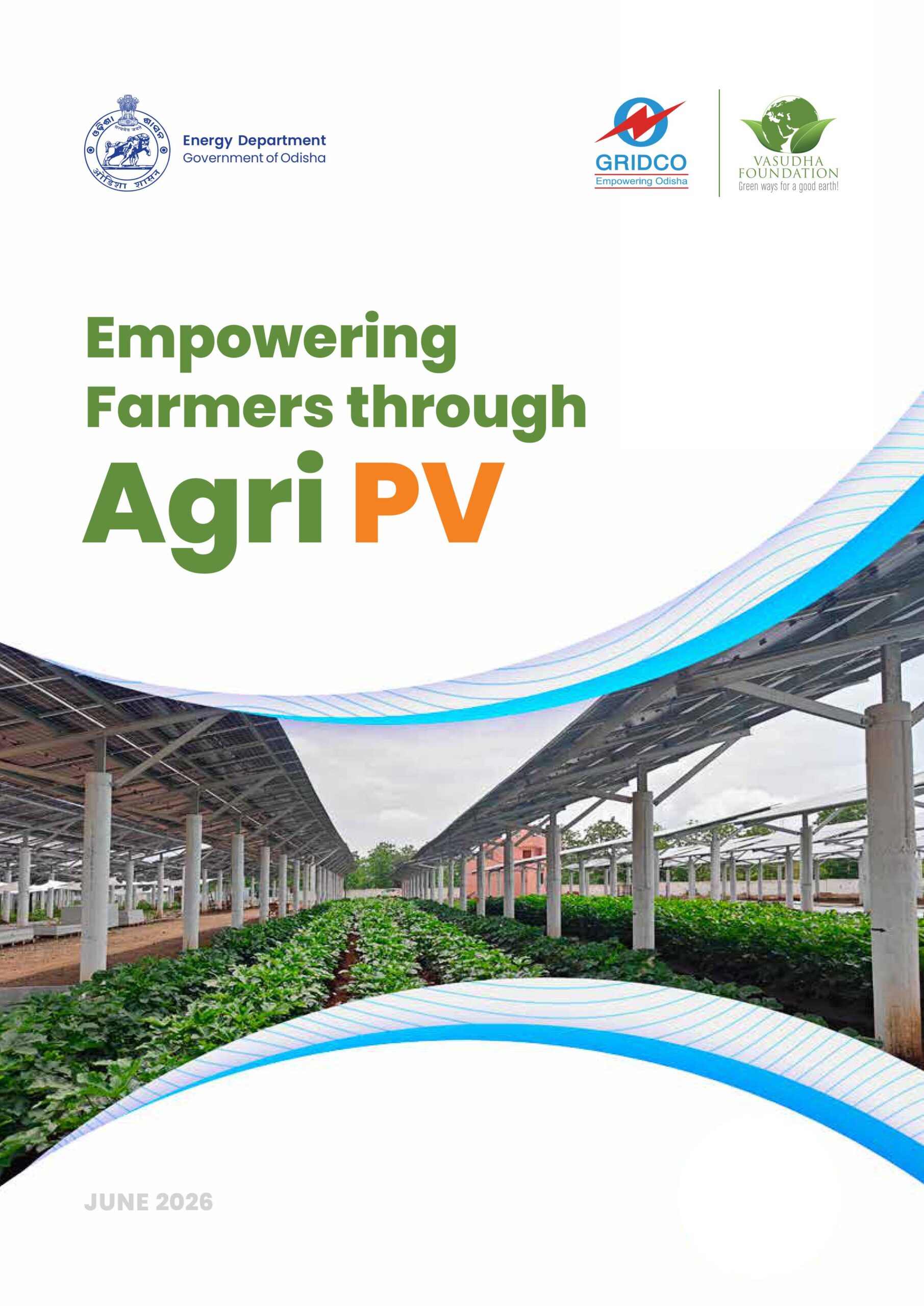
Agri PV (Agri Photovoltaics) – the dual use of land for solar power generation and agriculture – offers Indian states a strategic pathway to expand renewable energy capacity while strengthening farmer income and climate resilience.
This report consolidates an indicative catalogue of interventions developed through global landscape analysis and consultations with key stakeholders across the Agri PV value chain. It applies a Multi-Criteria Decision Matrix (MCDM) approach to prioritise interventions most relevant to the state context, ensuring evidence-based policymaking and efficient use of public resources.
Methodology and Findings
The methodology combines quantitative indicators (Tier 1) and qualitative judgements (Tier 2) to generate a composite ranking of interventions based on their expected impact, feasibility and inclusiveness. The process was designed to maintain analytical consistency, minimise duplication among overlapping interventions/criteria, and reflect ground-level realities in the Indian policy and market context.
- A capital grant of ₹1.05 Crore reduces upfront investment requirements (CAPEX) substantially, indicating that such mechanisms can strongly enhance investor confidence, especially in early-stage markets where equipment and installation costs remain relatively high.
- Reducing interest rates from commercial levels (10%) to concessional rates (7-8%) helps projects reach positive return thresholds – concessional finance alone may not achieve viable returns, but it plays an important role as an enabler when combined with tariff or capital grant support.
- Improving FiT rates from ₹3.00 to ₹3.50 per kWh highlights the importance of tariff-based revenue certainty – demonstrating that even marginal tariff improvement can significantly improve project financial viability.
Key Policy Recommendations
- Policy should emphasise mechanisms that lower capital costs and stabilise returns, enabling broader adoption among small and marginal farmers, alongside crowding in private financing.
- Establishing clear state-specific Agri PV guidelines and integrating Agri PV within existing renewable energy policies can create predictable regulatory pathways that can strengthen stakeholder trust.
- Developing coordinated institutional platforms can help establish practical demonstration sites that provide real-time evidence on crop performance, system design, and farm economics. These sites can also serve as centres for farmer training, technical support, and knowledge sharing.
- Governance-related interventions, such as model contracts and lease agreements for benefit sharing and support for FPO/co-operative-led models, remain essential for securing long-term social legitimacy and ensuring that farmers benefit fairly as deployment expands.
- Streamlined land-use permitting processes supported by GIS-based siting frameworks and harmonised land records can reduce project delays and minimise land-related disputes.
- Introducing premium valuation models for Agri PV produce and power, differentiated procurement frameworks and value-chain integration can diversify farmer income streams and improve commercial attractiveness.
- Scaling Agri PV requires an informed and skilled ecosystem. Structured capacity building and outreach programmes targeting farmers, local government agencies, DISCOMs, financial institutions, and extension networks can bridge information gaps and improve adoption readiness across the system.
About this Publication
Suggested citation: Jaideep Saraswat, Nikhil Mall, and Srinivas Ethiraj. 2026. Empowering Farmers through Agri PV. Vasudha Foundation.
Published: June 2026
Publisher: Vasudha Foundation
Pages: 72