



India has achieved its international target of 50% non-fossil power capacity by 2030 — five years ahead of schedule. Its renewable journey has expanded from under 90 GW in 2015 to 263 GW (as of 31st January, 2026), placing India among the world’s leading renewable energy markets. As renewable capacity continues to expand, the focus is now shifting from capacity addition to system readiness. Now, the challenge is the power system’s ability to integrate renewable energy reliably and efficiently. While the federal push is helping, states can turn the momentum into a transition story by integrating multiple axes depending on their strengths and opportunities. Lessons point to one imperative integrate readiness while scaling ambition.
To meet rising electricity demand, India still relies on conventional sources that generate almost 70% of its electricity. Expanding low-carbon power now requires embedding it within a diversified and reliable energy mix, where capacity growth is matched by system stability. This calls for coordinated action across various states. The national grid must evolve to manage higher shares of variable renewables, while states strengthen transmission planning, distribution reforms, storage deployment, and demand management. Integration depends on central institutions and states planning, investing, and operating in alignment. Early signs of this coordination are emerging, with reforms at both national and state levels aimed at strengthening long-term energy security and system resilience.
Federal Push Can Boost State Readiness
India is now the third-largest solar power producer in the world, given rapid deployment supported by national schemes like PM Surya Ghar Muft Bijli Yojana, Pradhan Mantri Kisan Urja Suraksha Evam Utthaan Mahabhiyan (PM KUSUM), backed by strong regulatory support and market acceptance. As India advances its clean energy portfolio, progress will be spearheaded by the States’ strengthening implementation and system readiness on the ground. And, they stand to gain from the federal push under the Union Budget 2026-27, which includes financial support and policy instruments aimed at accelerating clean energy deployment.
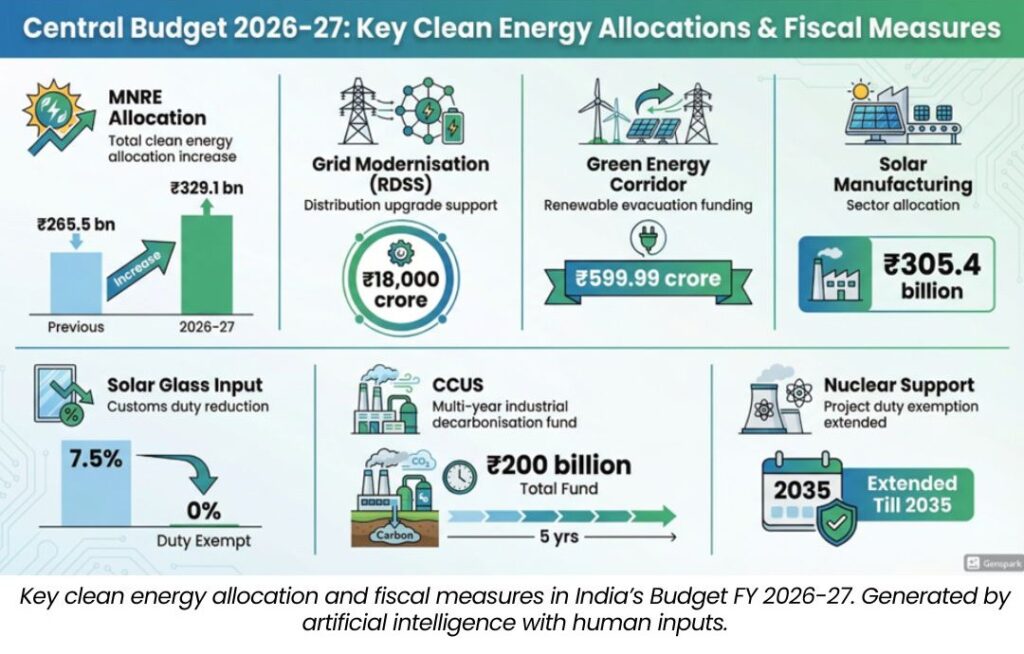
For example, incentives for Battery Energy Storage System (BESS) and customs duty exemptions for clean-tech components improve the economics of hybrid and round-the-clock renewable projects. In practical terms, this makes storage-linked and hybrid renewable projects more viable for state utilities and investors, helping states integrate higher shares of renewables without compromising reliability.The budget’s priority on Battery Energy Storage System (BESS) is reflected in the exemption of basic customs duty (BCD) on capital goods used for manufacturing lithium-ion cells for BESS. Since grid-connected storage remains at an early stage, the improved economics of storage manufacturing will address a critical challenge: balancing variable solar and wind generation with power demand. This emphasis onenergy storagealigns closely with developments in states such as Karnataka and Andhra Pradesh, which have moved beyond standalone renewable procurement toward hybrid and round-the-clock (RTC) power models. So, the financial support is likely to find faster uptake where such frameworks are already in place; for example, through projects like Pinnapuram Integrated RE Project (IREP), Andhra Pradesh has demonstrated how hybrid renewable-storage systems on barren land can deliver firm RTC power. The IREP, with 4,000 MW solar, 1,000 MW wind, and 1,680 MW of pumped storage, is capable of dishing out power for up to nine hours straight. Karnataka has mandated storage for solar plants to overcome its intermittency.
Another key component of the transition is critical minerals. In alignment with the National Critical Mineral Mission (NCMM), the budget 2026-27 (in continuation with last year’s 2025-26 budget), focuses on securing supply chains via a ₹34,300 crore, seven-year outlay, including zero customs duty on 12 key minerals. Key initiatives feature ‘Dedicated Rare Earth Corridors’ in the four states of Andhra Pradesh, Kerala, Odisha, and Tamil Nadu, a ₹7,280 crore Rare Earth Permanent Magnets (REPM) manufacturing scheme, and a push for overseas acquisition (e.g., lithium in Argentina). Tamil Nadu’s already established automobile supply chains consolidate its position as a leading EV manufacturing hub, while Andhra Pradesh’s Pinnapuram hybrid solar project — the world’s largest — can be a leading example for states to follow through in using barren land and utilising batteries.
In order to remain globally competitive, solar manufacturing has witnessed increasing allocations while simultaneously reducing the customs duty on sodium antimonate used in solar glass manufacturing. These measures may reduce India’s dependence on energy imports and improve supply-chain resilience. Rajasthan and Gujarat emerge as the country’s principal solar and hybrid generation hubs, supplying surplus clean power across regions. Large solar parks, access to transmission corridors, and proximity to emerging manufacturing hubs position these states to benefit disproportionately from duty exemptions on solar glass inputs and higher solar allocations, reinforcing the link between deployment scale and supply-chain localisation.
Under programmes like the National Bioenergy/Biogas Programme and SATAT initiative, India’s biogas sector has steadily expanded to support clean energy, organic waste conversion, rural livelihoods, and decarbonisation efforts. The budget’s support for biogas and compressed biogas (CBG) will improve the commercial viability of renewable gas. The exemption of the entire value of biogas from excise duty on biogas-blended compressed natural gas (CNG) creates a clear incentive by complementing the expansion of India’s bio-energy ecosystem, where ethanol blending has already reached 20%. Combined with the continuation of the Gram Urja Swaraj programme, these steps can accelerate rural energy independence. Uttar Pradesh, which has India’s highest CBG output, and Maharashtra, have advanced biopower deployment, strengthening distribution reliability and rural energy systems because bioenergy ecosystems are closely linked to agriculture, sugar mills, and distilleries. This excise duty relief on biogas-blended CNG strengthens these models by improving project viability without introducing new subsidy complexity.
The state and federal alignment is imperative in the power sector, where grid readiness remains the most critical differentiator. States that have invested in transmission planning, data systems, and district-level energy planning, supported by initiatives such as the Green Energy Corridor, are better placed to absorb additional renewable capacity without curtailment or reliability risks. The restructuring of the Power Finance Corporation and the Rural Electrification Corporation is expected to improve credit allocation, strengthening the power sector and enabling the clean energy transition.
What This Means for Energy Security and Climate Goals
With the persisting efficient policies in action as discussed above, India is continuing to enhance energy security, particularly by reducing exposure to imported fossil fuels, critical minerals, and clean-technology supply chains. Gujarat, for instance, aims to reach 105 GW by 2030 and contribute 20% to India’s 500 GW non-fossil energy goal. It has achieved ~45.8 GW of cumulative installations (as of 31st January 2026), becoming the largest contributor to the country’s RE capacity, accounting for 16.85% of India’s total. Gujarat has always had ambitious clean energy policies starting from 1993, while the most recent Gujarat Integrated Renewable Energy Policy of 2025 provides a unified framework for solar, wind, hybrid, distributed projects, and BESS.
However, the experience from ongoing state-level energy planning underscores the need for institutional and infrastructural readiness. Timely transmission expansion, grid flexibility, and effective coordination between central and state authorities are the key to success. Rather than replicating outcomes, states can replicate institutional mechanisms such as coordinated transmission planning, hybrid procurement design, and distribution reforms that underpin successful renewable integration.
Across India, states are taking rapid, coordinated strides to strengthen every pillar of the clean energy ecosystem. For instance, Gujarat’s latest budget 2026-27 allocates Rs. 15,000 crore for “green growth”; Uttar Pradesh and Maharashtra have focused on decentralised solar and biopower to improve rural energy reliability; Tamil Nadu is proactively building on its high wind utilisation through repowering policies while also leveraging its auto supply chain into an EV‑led industrial advantage, has amplified focus towards clean energy through allocation of ₹18,091 crore to the Energy Department in its latest state budget (2026-27) to the Energy Department; Andhra Pradesh’s hybrid renewable-storage projects like Pinnapuram; and Karnataka’s solar-powered pilot EV charging station with second-life batteries demonstrate circular economy integration and strong renewable project approvals.
The state-level approach to diversifying renewable energy aligns with India’s energy independence vision. As India works towards Viksit status by 2047, rising energy demand makes climate‑adaptive, clean energy pathways critical to reaching net‑zero by 2070. The twin goal will require strengthening governance at peri-urban and urban levels, while building resilient waste, water, and public infrastructure systems alongside clean energy expansion.
Find out more in the journal Petroleum Planning and Analysis Cell (January 2026, Edition V).
Authored By: Aishwarya Tewary, Policy Officer and Sweekruth M S, Assistant Manager, Climate Change at Vasudha Foundation.