



Authored By: Sandhya Sundararagavan & Dr Kala Nair K
An abridged version of this blogpost was first published in Deccan Herald.
Karnataka’s heat crisis no longer ends when the sun goes down. For decades, heat governance has been built around daytime extremes: maximum temperatures, heatwave alerts, and midday breaks. But this framework is not sufficient. It is becoming a continuous, 24-hour stress. Over the past two decades (2004–2024), the state has witnessed a steady rise in temperatures, with daytime highs increasing in the range of 0.13–0.7°C and night times in the range of 0.17–0.72°C across districts in the state. Karnataka now records nearly ten more warm nights each year than it did in 1990. The growing frequency of warm nights where temperatures remain unusually high after sunset means that heat is no longer an episodic daytime hazard. What makes this crisis particularly dangerous is its invisibility. While extreme daytime heat draws attention, warmer nights quietly erode human health by preventing recovery from daytime exposure (IPCC AR6). Without cooler nights, the human body cannot reset due to which the risks compound — heat stress accumulates, sleep is disrupted, and vulnerability rises sharply among the elderly, outdoor workers, and those with limited or no access to cooling. These impacts can intensify during ENSO (El Niño–Southern Oscillation) climatic events, when weakened monsoon circulation, reduced cloud cover, and prolonged dry conditions amplify both daytime and night time temperatures across southern India, thereby influencing the severity and persistence of heat exposure.
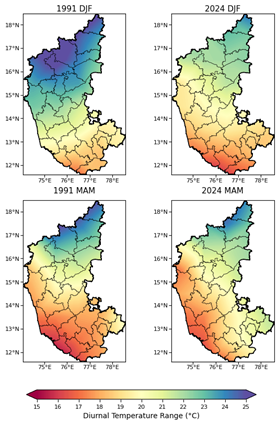
Source: Analysis by authors using IMD gridded daily minimum and maximum temperature for the winter months (December, January and February – DJF) and summer months (March, April and May – MAM).
More concerning is the change in the Diurnal Temperature Range (DTR), which varies across districts in the state between 15–25°C. A comparison of the 1991 and 2024 maps reveals a sharp shrinkage in DTR during the winter months (December–February) compared to summer (March–May), driven by rising nighttime temperatures in winter. In the coastal belt, rising humidity and increasing heat stress (NOAA heat index) ensures that nights remain stifling, even when temperatures are not at their peak. As of 2026, in coastal districts like Dakshina Kannada, Kasargod and Udupi, temperatures now routinely touch 38–40°C, but with higher humidity of about 50% makes it feel closer to 49–55°C. In the northern interior districts such as Kalaburagi and Vijayapura, prolonged high temperatures above 40°C are now followed by insufficient night-time cooling, extending the physiological burden, and adversely impacting public health, labour productivity, water availability, and overall heat stress conditions. Even the hilly regions like Coorg, Chikkmagalur, and Agumbe which were once considered natural refuges from heat are no longer immune to the heat stress. Temperatures in these areas are climbing above 30°C, with warmer nights threatening biodiversity and plantation crops like coffee, pepper. Several protected landscapes in Karnataka including Kudremukh National Park, Rajiv Gandhi Tiger Reserve, and Bandipur Tiger Reserve, are experiencing rising daytime temperatures frequently crossing 35–40°C and warmer nights with minimum temperatures rising 0.5–0.8°C over the past 4 decades. These changes are contributing to ecological stress and increasing risks to biodiversity and wildlife habitats.
Urban Karnataka presents an even more worrying picture. Over the past three decades, cities such as Mysuru have recorded nearly a 4°C increase in land surface temperature alongside declining (2%) vegetation cover, while Bengaluru has seen temperatures rise by as much as 15°C with a nearly 49% loss in green cover. Rapid and unplanned urbanisation, expanding built-up areas, and shrinking vegetation have intensified the Urban Heat Island (UHI) effect, keeping night-time temperatures elevated, especially in dense neighbourhoods. Over the past decade, both Bengaluru and Mysuru have also witnessed a sharp rise in warm nights, depriving residents of the cooling relief that nights once provided.
Karnataka now stands at a critical juncture, where heat is emerging as a persistent challenge across diverse terrains rather than a seasonal event. The recent Karnataka Heat Action Plan 2026 marks an important step towards strengthening heatwave preparedness, response framework and early warning systems. Going forward, effective implementation of these frameworks at taluka, block, and ward levels remains crucial. District heat action plans should include granular heat hazard projections and heat-risk assessments that are updated on a regular basis. Expanding automatic weather station networks, mandating collection and maintenance of heat-related data for undertaking heat-risk assessment, and establishing local heat-risk monitoring systems is essential for climate risk planning at sub-district levels. Implementation of simple heat adaptation strategies at sub-district level like creating better airflow through design of ventilation corridors, considering community centres and schools as climate shelters, designing public spaces with more shaded areas and innovative urban planning designs can be a good starting point. At the same time, integrated policies across sectors including climate, energy, urban planning, agriculture, and health care must be designed around the reality of continuous heat exposure for building long-term climate resilience.The broader lesson is clear. Climate change is not only intensifying extremes; it is altering baselines. Experts attribute this trend to a combination of global warming, climate variability such as ENSO events, rapid urbanisation, land-use change, shrinking green cover, and rising humidity in several districts. The impacts are already visible through rising heat-related health risks, declining labour productivity, increasing water stress, and growing cooling demand across urban centres. Immediate, sub-district level action is now critical. Given Karnataka’s diverse terrain and uneven heat exposure patterns, localised, district-specific interventions must be prioritised and implemented without delay.
Sandhya Sundararagavan is a Senior Advisor at Vasudha Foundation leading strategic innovation at the intersection of climate, energy transition and resilience | Dr Kala Nair K is a Manager at Vasudha Foundation specialising in climate hazard assessments and predictive modelling.