



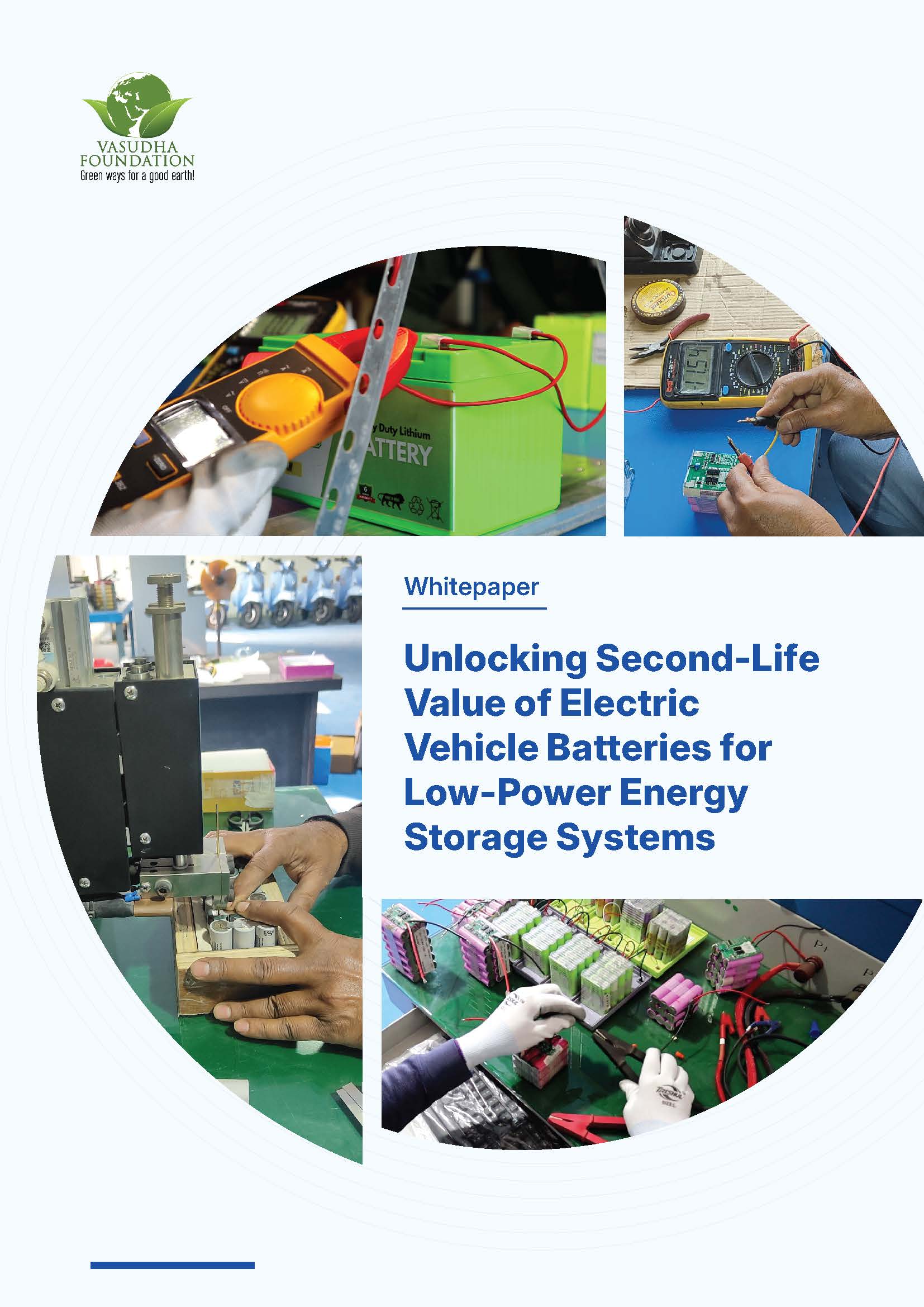
Electric Vehicle (EV) batteries that are retired after reaching reduced State-of-Health thresholds often retain substantial residual capacity that can be utilised in alternate applications. Existing research on second-life batteries has largely focused on grid-scale storage, with limited focus on low-power energy storage applications, which constitute a significant market. This study investigates the technical feasibility, economic rationale, and circular economy potential of refurbishing end-of-life (EoL) EV batteries.
The paper explores three central questions:
i. Whether refurbished EV batteries can reliably meet the operational requirements of low-power applications,
ii. How their performance compares with lead-acid batteries commonly used in such systems, and
iii. What methodological and ecosystem challenges influence large-scale refurbishment adoption.
Methodology and Findings
Refurbished lithium-ion battery modules were experimentally tested against equivalent lead-acid batteries across four representative applications: a Direct Current (DC) lamp, DC fan, agriculture spray pump, and small uninterruptible power supply (UPS). Results show that refurbished lithium-ion batteries perform equal to or better than lead-acid systems across all tested applications, demonstrating longer discharge durations, stable current delivery, and safe thermal performance under low-power operating conditions. Policy support, standardised refurbishment protocols, and improved battery data accessibility are identified as key enablers for scaling second-life battery ecosystems.
Key Policy Recommendations
- Recognize battery refurbishment as a distinct pathway under the Battery Waste Management Rules 2022, alongside recycling, rather than treating EoL batteries only as recycling feedstock.
- Allow refurbishers to earn Extended Producer Responsibility (EPR) credits for batteries they process and redeploy, which would improve access to batteries and create a more efficient supply channel.
- Create design incentives for refurbishment-friendly batteries, so manufacturers are encouraged to develop packs that are easier and safer to repair, test, and reuse.
- Reduce GST on refurbished batteries, ideally to a lower slab such as 5%, to improve price competitiveness versus new batteries and make refurbishment more commercially viable.
- Develop dedicated refurbishment standards and guidelines, since existing frameworks such as UL 1974 may be too costly and burdensome to apply universally in this context.
- Mandate testing of critical battery components at National Accreditation Board for Testing and Calibration Laboratories (NABL)-accredited laboratories, including the Battery Management System (BMS), thermal separators, connectors, and other safety-critical parts, before refurbished batteries are sold in the market.
- Permit market access only to refurbishers whose components have been tested and validated, to ensure safety and build consumer confidence.
- Provide financial assistance and policy parity for refurbishers, placing them on the same footing as upstream manufacturers and recyclers under central and state EV policies.
- Create mechanisms for battery usage-data sharing, so refurbishers can assess state of health more accurately and make faster, better refurbishment decisions.
About this publication
Suggested citation: Jaideep Saraswat, Rishabh Sethi, Nikhil Mall, Vyom Chaturvedi, Varun BR, Prakash Dev and Adityavardhan. 2026. Unlocking Second-Life Value of EV Batteries for Low-Power Energy Storage Systems. Vasudha Foundation.
Published: June 2026
Publisher: Vasudha Foundation
Pages: 40